
Search Party
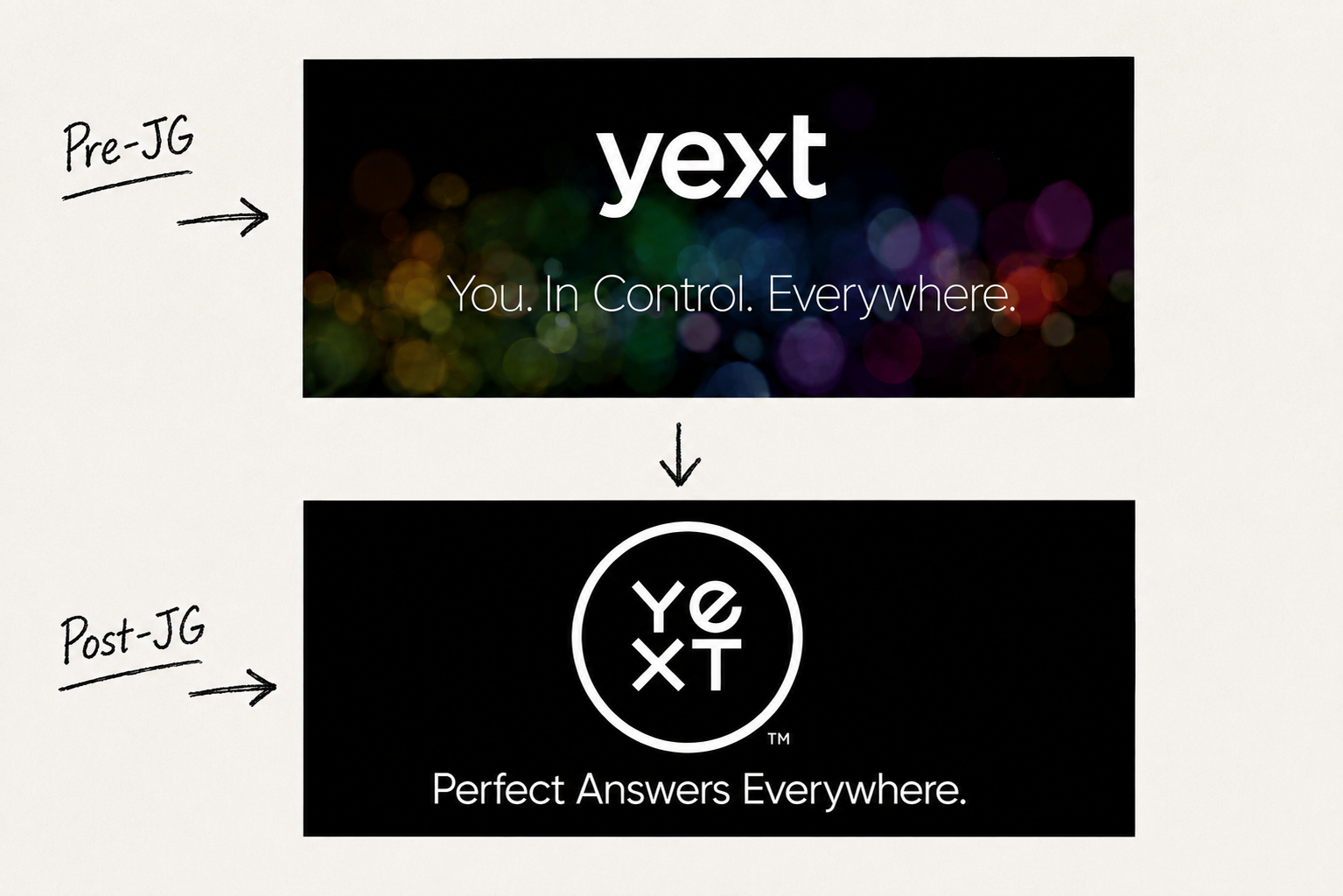
After leaving Wealthfront, I took on some consulting projects and was introduced to Yext, which needed help with a brand transformation.
B2B/enterprise brands hadn't naturally drawn me before — candidly, most felt pretty bland — but Yext stood out because of its Willy Wonka-esque founder and CEO, Howard Lerman, who loved storytelling and ran the business with real creative flair.
We hit it off immediately, and what I thought would be a short consulting gig turned into three years as CMO, doing some of my favorite work of my career.
Yext was founded in 2006 as the digital alternative to the Yellow Pages (the name is literally "next Yellow Pages" — get it?). It started by helping small and medium-sized businesses stay in control of their online information and became the gold standard in data knowledge management, which led to an IPO in 2017.
But Howard had a bigger ambition: to help every brand become as powerful a search engine as Google itself.
Google dominated search largely because the experience was just that good — but also because most business websites ran on outdated search technology, making the experience pretty terrible. Howard wanted to fix that and create an online world where there were "perfect answers everywhere."
So we repositioned Yext as The Answers Company and an AI search disruptor.
Searching for Answers
In the beginning, we focused on the future of search. Turns out, our best success would come when we went back in time. But more on that later.
To help create awareness of our new market position as The Answers Company, we did what most companies do and hired a top global creative agency.
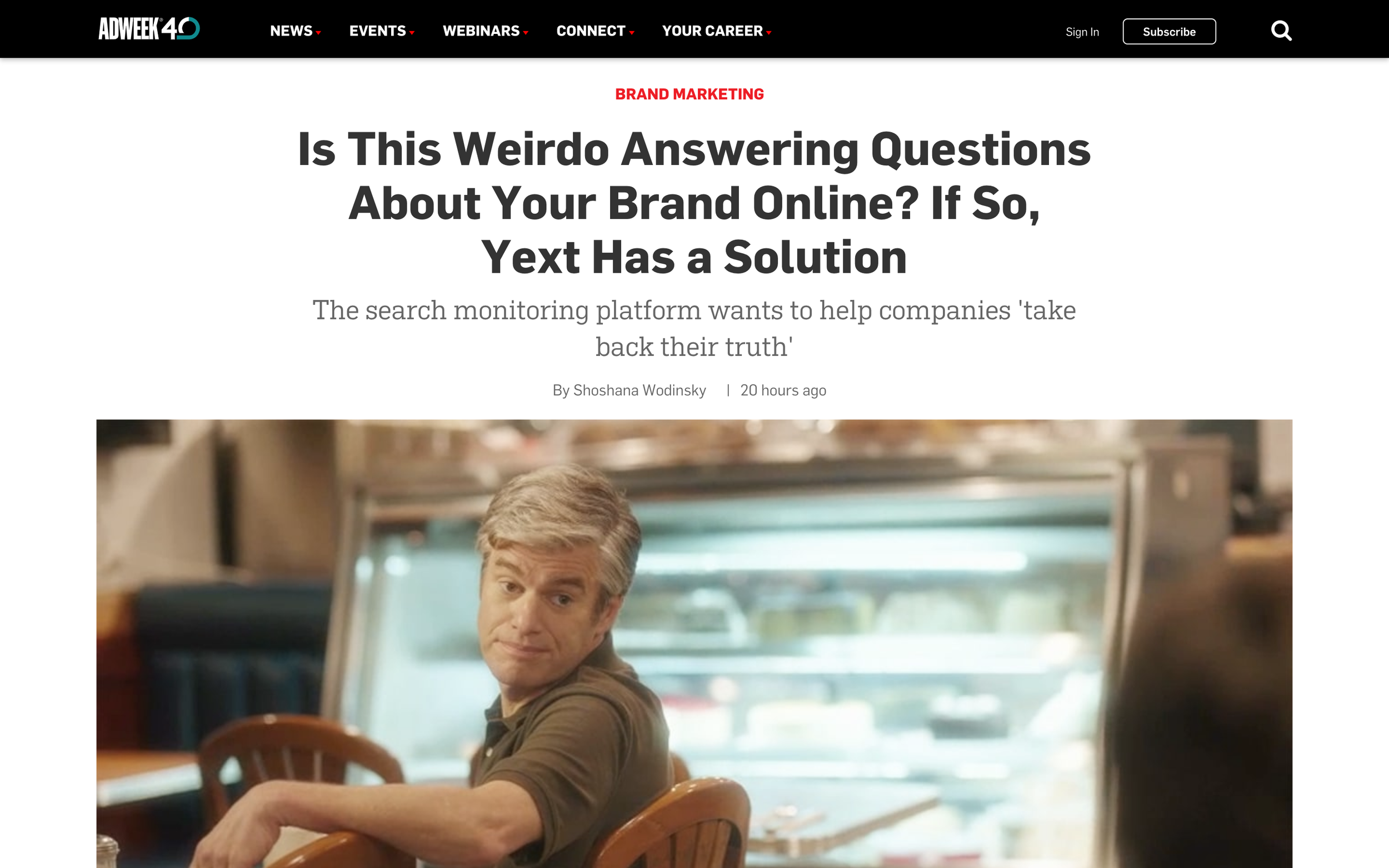
They came up with a central insight that anchored our brand awareness campaign: misinformation is a business problem.
That led to the development of a character, Todd Munion, a personifcation of online misinformation, followed by an elaborate commercial shoot across Manhattan and Brooklyn.
Weeks later we got the final cut and debuted it at a company all hands and… crickets.
The problem was glaring: the campaign didn’t accurately reflect what we did. We helped businesses power their own websites with a Google-quality search engine to surface direct answers to company quesitions. This spot suggested we eradicate misinformation from the internet. Whoops.
As is the case with working with big agencies, we got a lot of positive press about the creative execution. But we knew it wasn’t right, so we ended up shelving the campaign just a couple of months later, in large part because it just didn’t work, but also because COVID stopped everything from working (more on that later).
Party Search like it's 1999
After thing settled with the pandemic, it was time for a do-over.
But this time we built everything in-house, anchored on our own insights.
The first insight was that most business websites used a “vintage” search technology called keyword search, which hit the scene in the late ‘90s. A breakthrough at the time, it had since been outpaced by large language models (LLMs) and natural langauge processing (NLP) — the cornerstones of AI search.
The second was that using keyword search to power a website actually led to fewer transactions and more costly customer support tickets. In other words, business were leaving money on the table and driving up their own costs unnecessarily. We built a diagnostic tool showing brands exactly how bad they were at surfacing their own information.
So in order to sell the future of search, we needed to go back to the future: Search made for today, not 1999.
With our theme set we embarked on a fully integrated, multi-media campaign that we rolled out in strategic stages to build momentum.
Phase 1: Creating the Foundation
In addition to making sure our message was front and center on our website, we wanted to ensure we had the credibility to back it up. In addition to the diagnostic tool, which was the real centerpiece, we published a white paper titled The Curious Case of Keyword Search.
We also became presenting sponsor of Vox Media's Land of the Giants podcast season on Google, writing branded segments featuring our Chief Data Officer, Christian Ward, about how Yext is helping improve search for businesses.
This was an ideal pairing — a popular podcast about the evolution of search and the category’s resident king and a custom messaging about our own efforts to reshape the kingdom.


Phase 2: A ‘90s Takeover
To ramp up, we created a series of witty video ads comparing keyword search to’90s technology relics, like dial-up modems and fax machines — and we threw in a boy band bowl cut for good measure.
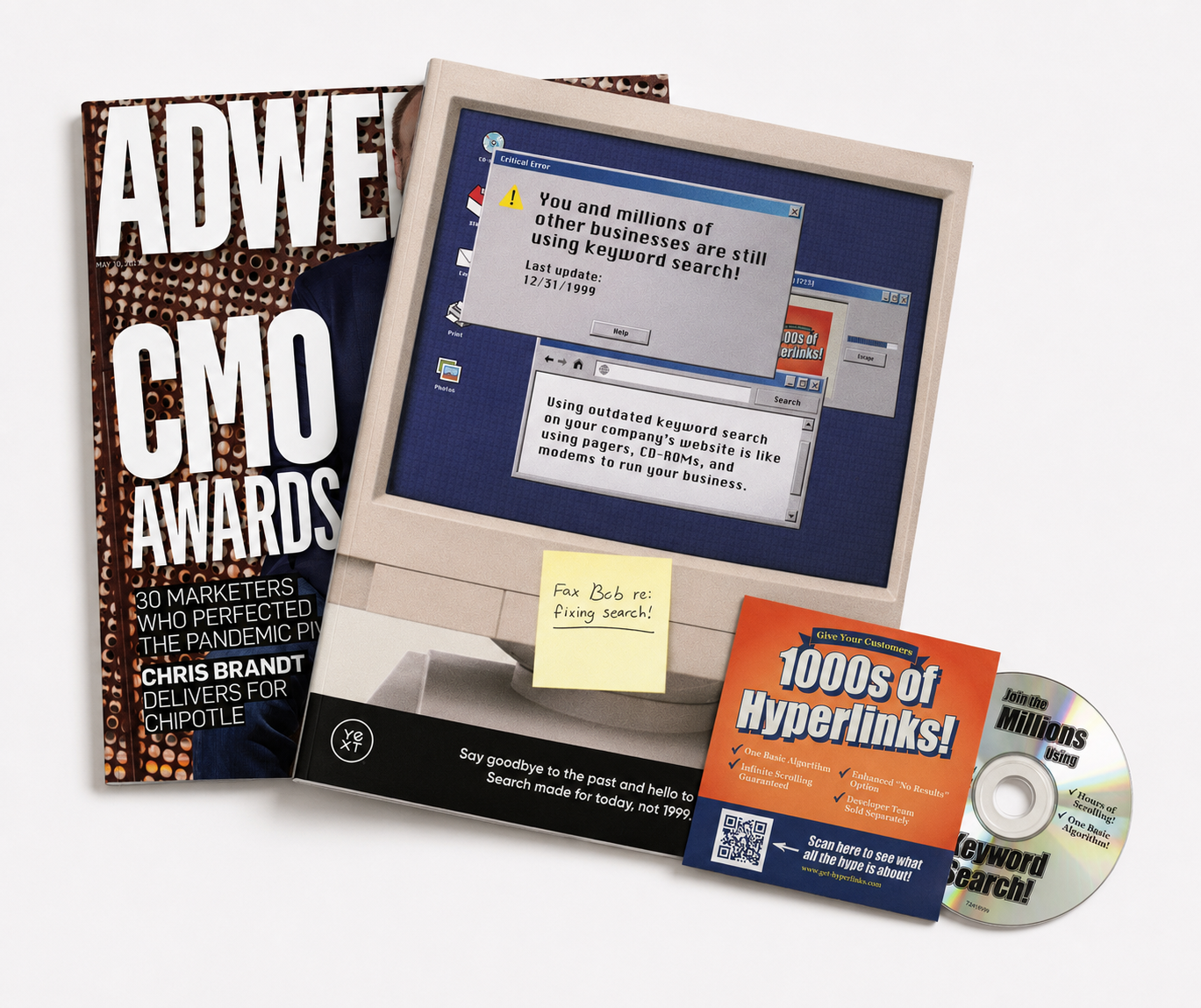
Next, in an effort to get in front of magazine marketing leaders we partnered with AdWeek for their annual CMO Awards issue.
We did a back-cover takeover ad and included an affixed CD, paying homage to the iconic AOL CDs of the ‘90s, while also promoting keyword search (ironically. of course).
A QR code on the CD packaging led to a custom choose-your-own-adventure-style game titled Escape the 90s, made to look — and feel — like you were trapped in last century. To get even more people to play the game, N*SYNC’s Lance Bass helped stir up buzz on Twitter with a video tweeted out from the Yext account.
Finally, we staked claim in our home city, taking over the streets of NYC with digital billboards that provided a real-time ‘90s trivia game while people waited for buses.
Phase 3: Yext's first national TV campaign
The concept was a ‘90s technology high school reunion.
In our story, Cell Phone, Storage, and Internet reunite at their class of ‘99 reunion, all looking sleek and modern now and commenting on how “lame” they were back then.
Then they all notice the one classmate that hasn't changed at all: Keyword Search.
He's a total loser who, unlike them, hasn’t innovated at all. Yet somehow he’s the most successful guy in the class because businesses keep buying him.
(Fun fact: the commercial was shot in the gym used in the movie Back to the Future, so we really were meant to go back in time.)
We teased the commercial prior to launch with a backcover yearbook ad in AdWeek portraying how the tech looked in their senior year in 1999, making their transition to their human form in the commercial more dramatic.
Along with the TV spot, we built a digital yearbook with backstories for the main characters and showing how much they each changed over the years — except for one, of course.


Phase 4: "Reunion at the Search Bar" events
After a year-plus of COVID isolation, we brought customers and prospects together around a literal search-bar-shaped cocktail bar in an effort to make the campaign come alive in the real world.
We held 40 events across multiple markets in the U.S. and Europe in record time, among the first enterprise companies to brave a newly vaccinated world and host public gatherings.

The Results
The 1999 achieved it’s goals: it helped cement our new identity as a search company, drove real demand, and helped land Yext a "Cognitive Search Provider" spot in Forrester's Now Tech Report — a big win for a new category entrant.
For the campaign, Yext won Brand of the Year at the Shorty Awards for the mid-sized businesses, alongside Duolingo for small and MTV for large.
We also took home top honors for humor and multi-platform use — validating, since our goal was to execute a fully integrated campaign with some sass.

No Budget? No problem!
I'm often asked in interviews how big my budget was at previous companies. Size matters to some, I suppose.
But the better question is how efficiently do you use what you have.
The 1999 campaign ran on a modest budget of $2M largely because we did nearly everything in-house. But being a CMO in the era of COVID also meant having to do more with less — sometimes literally no budget.
So what do you do? You figure it out.
One example was our "Season of Search" campaign we launched in late Q4 to drive sales of our services during a time when search activity spikes for most companies.
We rewrote 'Twas the Night Before Christmas and made it all about search, filmed it at Yext HQ, and cast willing and able Yext employees as our actors. It was a no-cost effort (well, a little money for pizza and beer) that yielded measurable and material incremental revenue. Not to mention, it was a great cultural moment for the company.
Another initiative that was built on a shoestring budget was the Yext Talks content platform, written, shot, and edited entirely in-house, starring our own execs as subject-matter experts.
From podcasts to product videos to national ad campaigns, we always found a way to create exceptional, award-winning, business-driving work — without breaking the bank.

An Unexpected Purpose
It’s less than ideal to reposition your company and hit the market in earnest just weeks before the whole world shuts down.
At that time, businesses were making tough decisions on where they could cut expenses, and subscription-based software solutions like ours had to be considered “must have” to survive.
Unfortunately when foot traffic stopped, our legacy Listings product got put on ice. Thankfully we had a whole new pitch with AI search, but it was nearly impossible to get attention during this frenetic scramble to cut costs.
Fortunately, we got an unlikely assist because of the pandemic that helped validate our new offering and garner some much needed awareness.
We were tapped by the World Health Organization (W.H.O.), the U.S. Department of State, the states of New Jersey and Alabama, and the City of South Bend, Indiana to build Yext-powered COVID-19 information hubs to help ensure that the public could get answers to their questions in real-time. This was especially important early in the pandemic when so much was unknown and misinformation was all over the internet.
Many of our own customers were drowning in new COVID-related questions and they were struggling to keep up. These public-sector partnerships became invaluable case studies and validation of our technology. Suddenly we went from “nice to have” (or worse, “has been”) to must have.
Turns out, in every crisis there is an opportunity.

